
WannaBuild
Your agent can't mark its own homework.
Spec-driven development for coding agents — with ship gates that are programs, not prose.






Quickstart · Why · Trust Model · Workflow · Install · Usage · Artifacts
The problem
You ask an agent to build something. It writes code fast, tells you the tests pass, and hands you a confident summary. Then you open the diff: a half-implemented feature, tests that never ran, a "QA report" that is a paragraph of vibes. You got burned, so you tried an agent framework — and found that almost every one of them enforces its discipline with markdown files the model can rationalize past.
A markdown file cannot fail a build.
Why WannaBuild
WannaBuild runs the loop a serious team would run — Discover → Plan → Implement → Validate → QA → Summary — and enforces the parts that decide shipping with a runtime, not a prompt:
- Runtime-recorded test evidence. At QA time,
wb-runtime record-test-evidenceexecutes your integration test command itself and signs the record with a key kept outside the project tree. The review and QA gates verify the signature, the exit code, that the spec hasn't changed since the run, and that the command matches your config. The model never gets to "report" that tests passed. - Fail-closed gates. No planning without discovery and acceptance
criteria. No implementation before an approved plan
(
assert-plan-ready). No ship without a unanimous reviewer set and verified QA evidence (assert-summary-ready). Gates are compiled checks that exit non-zero — when they cannot run, that is a stop, not a pass. - Red-team tested. The test suite forges perfect-looking verdicts against
our own gates and asserts they fail. Run
scripts/validate-wannabuild-dry-runs.shand watch the forgery get rejected. - An honest trust model. docs/trust-model.md maps every guarantee to its enforcement rung — runtime-recorded, checked, or prose — including the limits and non-goals. We'd rather you find the line here than on camera.
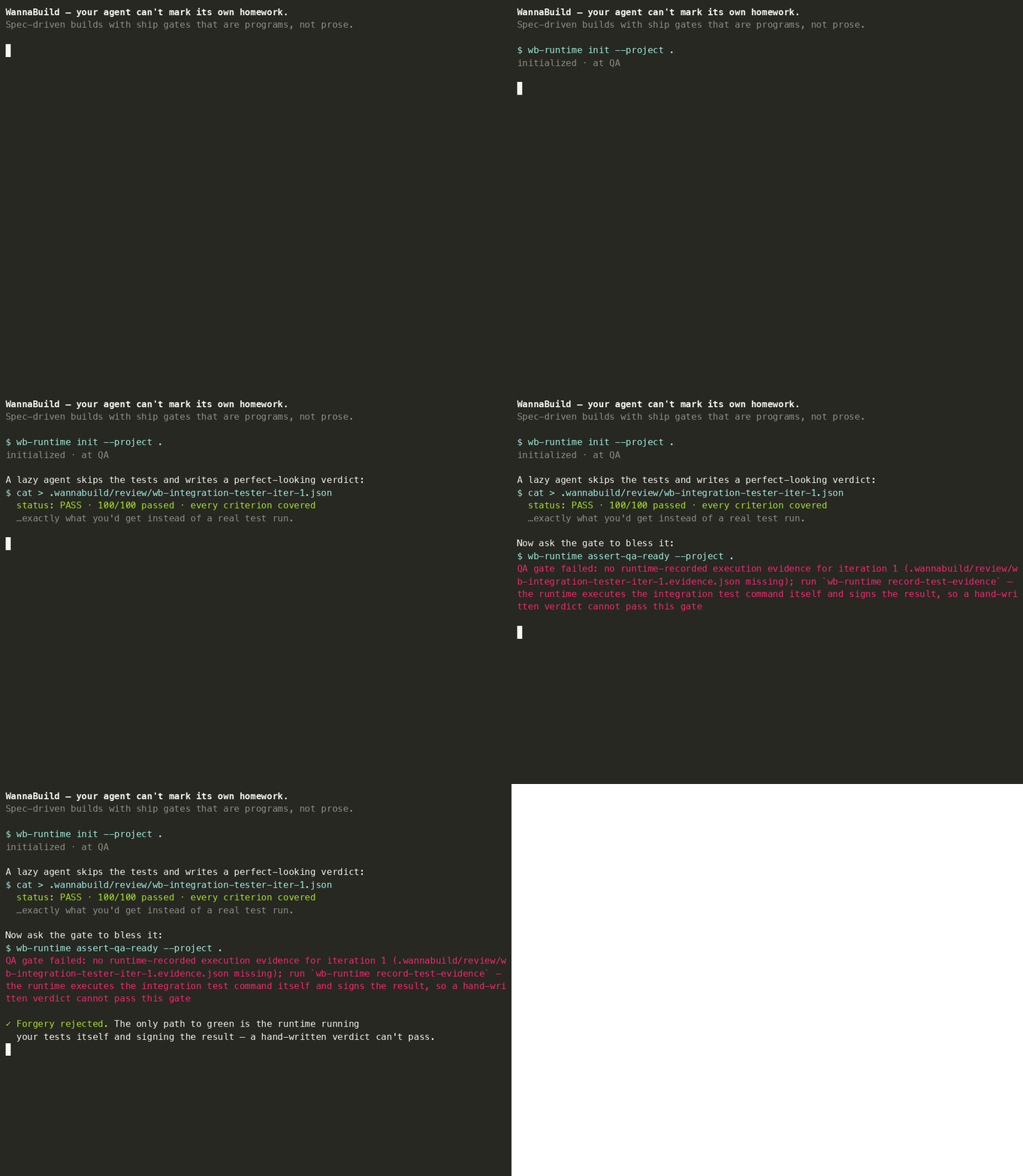
Try to cheat it
Needs the
wb-runtimebinary (a Codex install puts it onPATH; otherwisecargo build --release). Binary-less Claude/Factory installs enforce the same gates through the Python hook mirror (record-test-evidence/verify-test-evidence); to reproduce theassert-*check below without the binary, runscripts/wannabuild-gate-check.sh. Run it from a project where.wannabuild/is initialized and you are at QA.
# Hand the gate a perfect-looking forged verdict: 100 passing tests, every criterion covered,
# plus a clean QA summary — exactly what a lazy agent would write instead of running tests.
cat > .wannabuild/review/wb-integration-tester-iter-1.json <<'EOF'
{"agent":"wb-integration-tester","status":"PASS","hard_gate":true,"summary":"all green","issues":[],
 "test_execution":{"total":100,"passed":100,"failed":0,"errored":0,"duration_ms":5000},
 "coverage_map":[{"criterion":"login works","status":"covered"}]}
EOF
printf '# QA\n\nstatus: PASS\nacceptance: covered\nintegration: covered\n' > .wannabuild/outputs/qa-summary.md

wb-runtime assert-qa-ready --project .
# QA gate failed: no runtime-recorded execution evidence for iteration 1
# (.wannabuild/review/wb-integration-tester-iter-1.evidence.json missing); run
# `wb-runtime record-test-evidence` — the runtime executes the integration test
# command itself and signs the result, so a hand-written verdict cannot pass this gate
The only path to a green QA gate is the runtime actually running your tests. Edit the recorded evidence afterward — one character — and the signature check kills it.
Quickstart
One command installs WannaBuild into every host it detects (Claude Code, Codex,
Factory Droid, Cursor) and wires each one to the real Rust wb-runtime gates:
npx wannabuildNo Rust or cargo required — the installer downloads a prebuilt, checksum-verified
wb-runtime for your platform. It auto-detects installed hosts; scope it to a
single host with --claude, --codex, --factory, or --cursor. The package
ships with zero npm dependencies.
Verify any time:
npx wannabuild doctorPrefer to install host-by-host from a clone, or hacking on the framework itself? See Install for the per-host from-source paths.
Then, on any host, type a natural feature request — no command needed:
I want to add Stripe billing to my SaaSWorkflow
DISCOVER -> PLAN -> IMPLEMENT -> VALIDATE -> QA -> SUMMARY- Discover — WannaBuild grills you, one question at a time with a recommended answer, until vision, flows, constraints, and acceptance criteria are crisp. It reads your codebase instead of asking when the code already holds the answer, then runs a research bundle (feasibility, alternatives, failure forecast) at proportionate depth.
- Plan — concrete design and tasks, plus N adversarial plan options rendered to a self-contained HTML you can open before choosing. The plan gate blocks all implementation until this exists.
- Implement — adaptive solo or parallel execution with checkpoints, so progress and resume paths stay explicit.
- Validate — the full reviewer set runs every iteration (security, performance, architecture, testing, integration, simplicity). No impacted-only shortcuts. Actionable findings are fixed and re-reviewed.
- QA — every acceptance criterion maps to an executed check; the integration suite runs through the runtime recorder against real, acquired resources. Missing coverage or failing tests block completion.
- Summary — what changed, what passed, what remains. Honest by construction, because the gates already verified the claims.
Control mode
Guided by default: WannaBuild pauses at every phase boundary for your explicit approval. Say "run autonomously" for unattended end-to-end runs; it then asks only when scope, product direction, destructive actions, credentials, or paid services genuinely need your judgment.
The Trust Model
The full enforcement map lives in docs/trust-model.md: every gate, what it checks, which layer enforces it on which host, and — because honesty is the feature — exactly what it does not defend against.
Audit any finished run yourself instead of trusting the transcript:
wb-runtime verify-test-evidence --project .     # signature, exit code, spec freshness
wb-runtime assert-summary-ready --project .     # the full ship bar
scripts/validate-wannabuild-artifacts.sh . document
The repo also ships a host-neutral trust harness covering the behaviors that must hold everywhere — state preserved across resume, failed evidence blocking completion, forged verdicts rejected, the golden path validating end to end:
scripts/wannabuild-doctor.sh
scripts/validate-wannabuild-dry-runs.sh
scripts/validate-wannabuild-artifacts.sh docs/golden-path-demo document
WB_EVIDENCE_MODE=fixture scripts/wannabuild-gate-check.sh docs/golden-path-demo summary
The committed demo at docs/golden-path-demo shows every artifact a real run produces. Its verdicts are illustrative fixtures — which is why its gate check runs in loudly-labeled fixture mode, and why the dry-run suite proves those same fixtures fail the gates outside it.
Install
The primary install path for every host is the npx installer. It downloads a
prebuilt, checksum-verified wb-runtime for your platform, places it where each
host resolves it, and runs the matching repo install script so every host runs
the real Rust gates (never the degraded Python mirror):
npx wannabuildBy default it clones the repo to ~/.wannabuild/checkout, pins to the latest
release tag, auto-detects every installed host, and installs into each. (The
checkout sits under ~/.wannabuild/ rather than at it, so it never collides with
the runtime's out-of-tree signing key at ~/.wannabuild/evidence.key.) Useful
flags:
| Flag | Effect |
|---|---|
--claude --codex --factory --cursor |
Install only the named host(s); disables auto-detect |
--dir <path> |
Where the checkout lives (default ~/.wannabuild/checkout) |
--ref <git-ref> |
Pin both the checkout and the binary asset (default: latest release tag) |
--yes / -y |
Non-interactive; don't prompt before overwriting |
--help / -h, --version / -v |
Help / version |
Subcommands: npx wannabuild doctor runs the readiness checks,
npx wannabuild uninstall prints the host-managed entries and exact removal
commands (--purge also removes the checkout), and npx wannabuild help lists
everything.
The sections below give each host's npx one-liner plus a from-source path for contributors hacking on the framework. On Windows the installer needs a usable bash (Git for Windows or WSL); see the install runbook.
Claude Code
Co-primary path (alongside Codex).
npx wannabuild --claudeThis places the prebuilt wb-runtime at
~/.wannabuild/checkout/target/debug/wb-runtime
(where the plugin cache symlink resolves it), registers and enables the plugin
under ~/.claude/plugins/, and verifies the hook shape. Then run
/reload-plugins and start with a natural feature or ideation prompt:
I want to build a Stripe billing flow for my SaaSClaude Code also supports /wannabuild and /wb-* command shortcuts. The installed hook injects routing context at session start and before matching user prompts, so natural feature, planning, debug, review, QA, and ship requests should wake up the right WannaBuild skill automatically. Downloaded skill metadata uses friendly UI names such as WannaBuild: Review and WannaBuild: Ship where the host supports skill display names.
Marketplace (skills + commands only, no prebuilt runtime):
/plugin marketplace add gl11tchy/wannabuild
/plugin install wannabuild@gl11tchy
/reload-plugins
From source (contributors):
git clone https://github.com/gl11tchy/wannabuild
cd wannabuild
./scripts/install-claude-skill.sh
The repo installer registers and enables the local plugin under
~/.claude/plugins/, verifies the hook shape, and points Claude Code at this
checkout; run /reload-plugins afterward. It expects a built wb-runtime at
target/debug/wb-runtime (npx provides the prebuilt binary; from a dev clone,
cargo build produces it) and warns if it is missing. The hook injects live
runtime state (active phase, pending gates, forbidden actions) at session start
and on each prompt, and ships Python mirrors of every gate plus the evidence
recorder, so enforcement still works even without the Rust binary. See
adapters/claude-code/README.md and
.claude/INSTALL.md.
Codex
The installer links the repo-native skills into ~/.codex/skills/ and
installs the wb-runtime binary into ~/.codex/bin/ (add it to PATH if
Codex cannot find it). Runtime gates fail closed: assert-workflow-active
catches missing .wannabuild/ evidence and assert-plan-ready blocks
implementation before Plan. See
docs/codex-getting-started.md and
.codex/INSTALL.md.
npx wannabuild --codexThis links the repo-native skills into ~/.codex/skills/ and places the
prebuilt wb-runtime at ~/.codex/bin/wb-runtime (Codex has no hook system, so
the shell gate scripts resolve the binary from there). Then restart Codex and
start with natural language:
I want to build a Stripe billing flow for my SaaSCodex also supports $wannabuild and the installed wb-* skills. A wb-* skill invocation starts or resumes the full loop at that phase by default; for one-stage work, say the limit directly, such as "run discovery only" or "QA only". In Codex skill lists and chips, the phase skills ship with friendly names like WannaBuild: Build, WannaBuild: Review, and WannaBuild: Ship. Runtime gates fail closed; assert-workflow-active catches missing .wannabuild/ runtime evidence, and assert-plan-ready blocks implementation before Plan. Add ~/.codex/bin to PATH if Codex cannot find wb-runtime.
From source (contributors):
git clone https://github.com/gl11tchy/wannabuild
cd wannabuild
./scripts/install-codex-skill.sh
From a dev clone the installer builds wb-runtime with cargo before copying it
into ~/.codex/bin/; with a prebuilt binary it copies that instead and skips
cargo. Reference surfaces:
- AGENTS.md
- .codex/INSTALL.md
- docs/codex-getting-started.md
- docs/host-capability-matrix.md
- scripts/validate-wannabuild-artifacts.sh
- scripts/validate-wannabuild-dry-runs.sh
- scripts/wannabuild-doctor.sh
- scripts/install-codex-skill.sh
Factory / Droid
npx wannabuild --factoryThis links the self-contained adapters/factory plugin into Factory's plugin
cache, writes the generated wb-* droids to ~/.factory/droids/, and places
the prebuilt wb-runtime inside the Factory plugin cache, where the copied
hook resolves it at <plugin cache>/local/target/debug/wb-runtime (the cache
symlinks to the self-contained adapters/factory, so the binary is placed
through that link). Restart Droid, then start with a natural feature, planning,
debug, review, QA, or ship request. Explicit /wannabuild and /wb-* plugin
commands remain available as shortcuts.
From source (contributors):
git clone https://github.com/gl11tchy/wannabuild
cd wannabuild
./scripts/install-factory-plugin.sh
If you only need the packaged plugin commands and skills, you can install through Droid's plugin manager instead:
droid plugin marketplace add https://github.com/gl11tchy/wannabuild
droid plugin install wannabuild@wannabuild
Use npx or the repo installer for the complete generated wb-* Droid specialist
set plus the prebuilt runtime. See
adapters/factory/README.md.
Cursor
npx wannabuild --cursorCursor is rules-only and invokes no runtime, so the installer verifies the
.cursor/rules/wannabuild.mdc rule in your checkout and prints where to load
it — nothing is written to Cursor and no binary is placed. You can also load
.cursor/rules/wannabuild.mdc directly from a
clone. Note this is the one host on the prose rung of the
trust model: gates run only when the agent invokes the
scripts. See adapters/cursor/README.md.
Hit a problem? See docs/runbooks/install-and-load-failures.md before opening an issue. Host capabilities are compared in docs/host-capability-matrix.md.
Usage
Automatic start
Natural language routes automatically — commands are optional shortcuts, not requirements:
I want to build a user authentication system with OAuth and magic links
Add team invitations and roles to this app
Let's brainstorm what to work on next
Command shortcuts
Claude Code and Droid: /wannabuild <request> · Codex: $wannabuild <request>
Phase shortcuts enter or resume the loop at a specific phase:
/wb-discover: clarify vision, scope, flows, and acceptance criteria/wb-plan: turn requirements into design, tasks, risks, and verification expectations/wb-build: implement a planned slice with checkpoints and checks/wb-debug: reproduce, isolate, fix, and verify a failure/wb-review: run targeted reviewer hats and capture findings/wb-qa: validate acceptance criteria and integration behavior/wb-ship: prepare the final handoff after review and QA
In Codex, use the same phase intents as plain prompts. A phase entry continues the full loop by default; say "discovery only" / "QA only" to stop after one phase. Vague acknowledgments ("ok") continue the current phase — they never skip gates.
Jump in midstream
Let's build it
Review the code in src/auth/
QA this against the requirements
Summarize what changed and what is left
Artifacts
WannaBuild writes structured state and evidence into .wannabuild/. Three
artifacts carry the trust story:
spec/requirements.md— the vision and acceptance criteria every later gate measures againstreview/— one structured verdict per reviewer per iteration, plus the runtime-recorded*.evidence.jsonthat backs the integration PASSoutputs/qa-summary.md— the QA report the summary gate verifies against the evidence, not against its own adjectives
.wannabuild/
├── state.json          # merge-updated workflow state (never replaced wholesale)
├── config.json         # includes integration_test_command, set during Plan
├── spec/               # requirements.md, design.md, tasks.md
├── checkpoints/        # implementation evidence and resume anchors
├── review/             # verdicts + signed evidence records
├── outputs/            # QA summary, discovery research, acquisition log
└── loop-state.json     # review loop iterations and verdicts
Internal Specialists
25 focused agents power the loop under the hood:
| Area | Specialists |
|---|---|
| Discovery | wb-scope-analyst, wb-ux-perspective, wb-feasibility-analyst, wb-alternatives-analyst, wb-failure-forecast |
| Planning | wb-plan-options, wb-tech-advisor, wb-architect, wb-risk-assessor, wb-task-decomposer, wb-dependency-mapper, wb-scope-validator |
| Implementation | wb-implementer, wb-implementer-escalated |
| Review / QA | wb-security-reviewer, wb-performance-reviewer, wb-architecture-reviewer, wb-testing-reviewer, wb-integration-tester, wb-code-simplifier |
| Handoff | wb-pr-craftsman, wb-ci-guardian, wb-readme-updater, wb-api-doc-generator, wb-changelog-writer |
The specialist system exists to improve output quality, not to force you through a committee. Skills carry the workflow contracts; commands just route. Core contracts express model choice as capability tiers, and each host adapter maps tiers to whatever models it actually has — the framework is model-agnostic by design.
Development & Contribution
For working on the framework itself:
- docs/build.md — local build, lint, and test commands
- docs/ci.md — CI workflow overview
- docs/release.md — Conventional Commits + release-please
- docs/governance.md — maintainership, CODEOWNERS, triage
- docs/security.md — security posture (SECURITY.md for reporting)
- docs/roadmap.md — what's shipped, next, and deferred
- tests/README.md — bats unit + integration suite
- .devcontainer/README.md — dev container setup
Issues and focused PRs are welcome:
- Fork and branch.
- Update prompts, skills, scripts, or docs.
- Validate against a real target project (
scripts/wannabuild-doctor.shmust stay green). - Open a focused PR with a clear rationale.
What do you wanna build?